Meta ads, run by a senior buyer.
Checked every morning.
Meta now finds the audience; your creative and your data decide whether it finds the right one. We run your account with a senior media buyer, a steady supply of genuinely different ads and our Media Desk agent checking every ad every morning. Every decision about your money is made by a person.
Who it’s for: ecommerce and lead-gen brands on Facebook and Instagram, typically from about £3k a month, who need a senior buyer part-time, interim or ongoing. Everything here rests on accurate tracking, a profitable offer and a landing page that converts. The film shows Media Desk on a fictional demo account; no client results are claimed.
Is this you?
- Results swing week to week and nobody can say why
- The same three ads have carried the account for months
- Meta’s ROAS and Shopify’s revenue don’t agree
- The founder, or a generalist, is running the ads between other jobs
Why it usually goes wrong.
- Too many look-alike ads. Meta’s system can treat near-identical ads as one, so thirty tweaks of one template add little.
- Fragmented structure. Budgets spread across many ad sets never leave the learning phase, which Meta says needs around 50 results a week per ad set.
- Weak signal. Pixel-only tracking or a poor Conversions API setup leaves Meta optimising on partial data.
- Judged too early, or on the wrong number. Ads paused after a day or two, or scaled on platform ROAS that counts existing customers and sales that would have happened anyway.
How we run a Meta account.
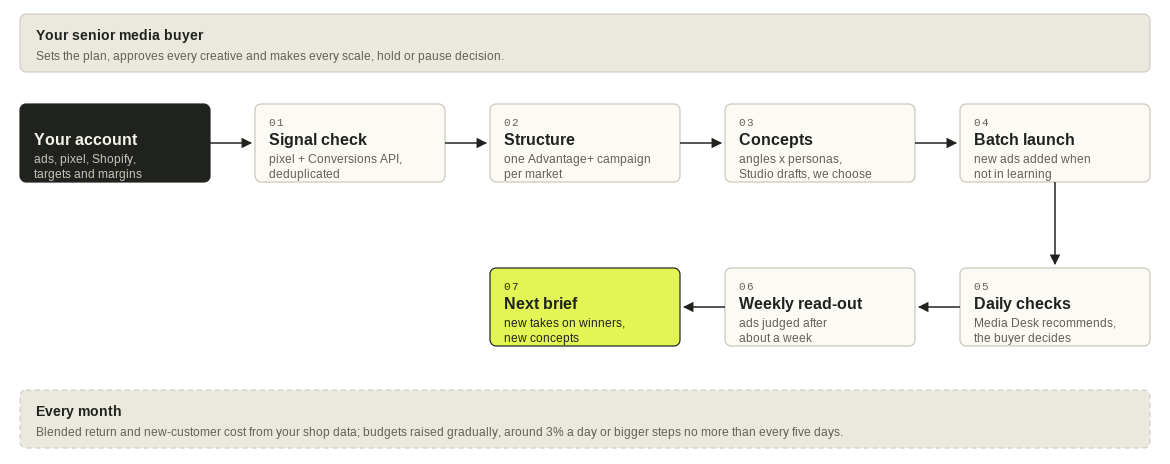
Your senior media buyer: Sets the plan, approves every creative and makes every scale, hold or pause decision.
How the work runs.
Daily
Media Desk checks every ad against your targets. Your buyer approves or rejects each scale, hold or pause call.
Nothing changes without a person.Weekly
New ads added in a batch when the ad set isn’t in learning. Read-out of hook rate, hold rate and cost per sale by angle, and the next briefs.
Creative never goes stale.Monthly
Blended return and new-customer cost from your own sales data, plus Meta’s new-vs-existing-customer breakdown. Budget moved to what’s working.
Judged on your numbers.Quarterly
Concept bank refreshed and structure reviewed as spend grows, including a separate testing campaign once it’s justified.
Room to grow, not just maintain.The method, point by point.
- Consolidate the accountUsually one Advantage+ campaign and one ad set per market, aiming for around 50 conversions a week so it can leave the learning phase. We split further only where margins or markets genuinely differ.
- Structure that grows with spendUp to about £12k ($15k) a month we test new ads inside the main campaign. From around £25k ($30k) we add a separate testing campaign, one ad set per concept, and move winners across. (Dara Denney’s budget tiers; Ben Heath prefers fewer splits.)
- Genuinely different ads10–20 live ads per ad set, mixing proven winners with new concepts: new angles, formats, people and first frames, not small tweaks of one template.
- Patient testingNew ads get about a week before we judge them, longer at low volume, in line with Meta’s own testing guidance. We keep the ads carrying spend switched on; switching off the top ad often hurts results.
- Protect the learning phaseChanges are batched, and new ads go in only when the ad set isn’t in learning, because significant edits reset it.
- Scale graduallyBudgets raised around 3% a day, or in bigger steps no more often than every five days, while cost per sale holds. No duplicate campaigns.
- Fix the signal firstPixel plus Conversions API, deduplicated as Meta recommends, with Event Match Quality improved using Meta’s recommended actions in Events Manager.
- Measure what Meta can’tMeta’s audience-segment reporting shows how much spend reaches existing customers; incremental attribution and your own shop data show what Meta really added. Opportunity Score is a checklist we review, not a to-do list.
What we report.
- Cost per sale or leadagainst your target, not the platform’s default
- MER / new-customer CACfrom your shop or CRM, not Meta’s own reporting
- Hook rate3-second views ÷ impressions, per video
- Hold ratehow many keep watching past the hook
- Creative hit rateshare of new concepts that become winners
- Frequencyso fatigue is caught before costs rise
The agent behind it.
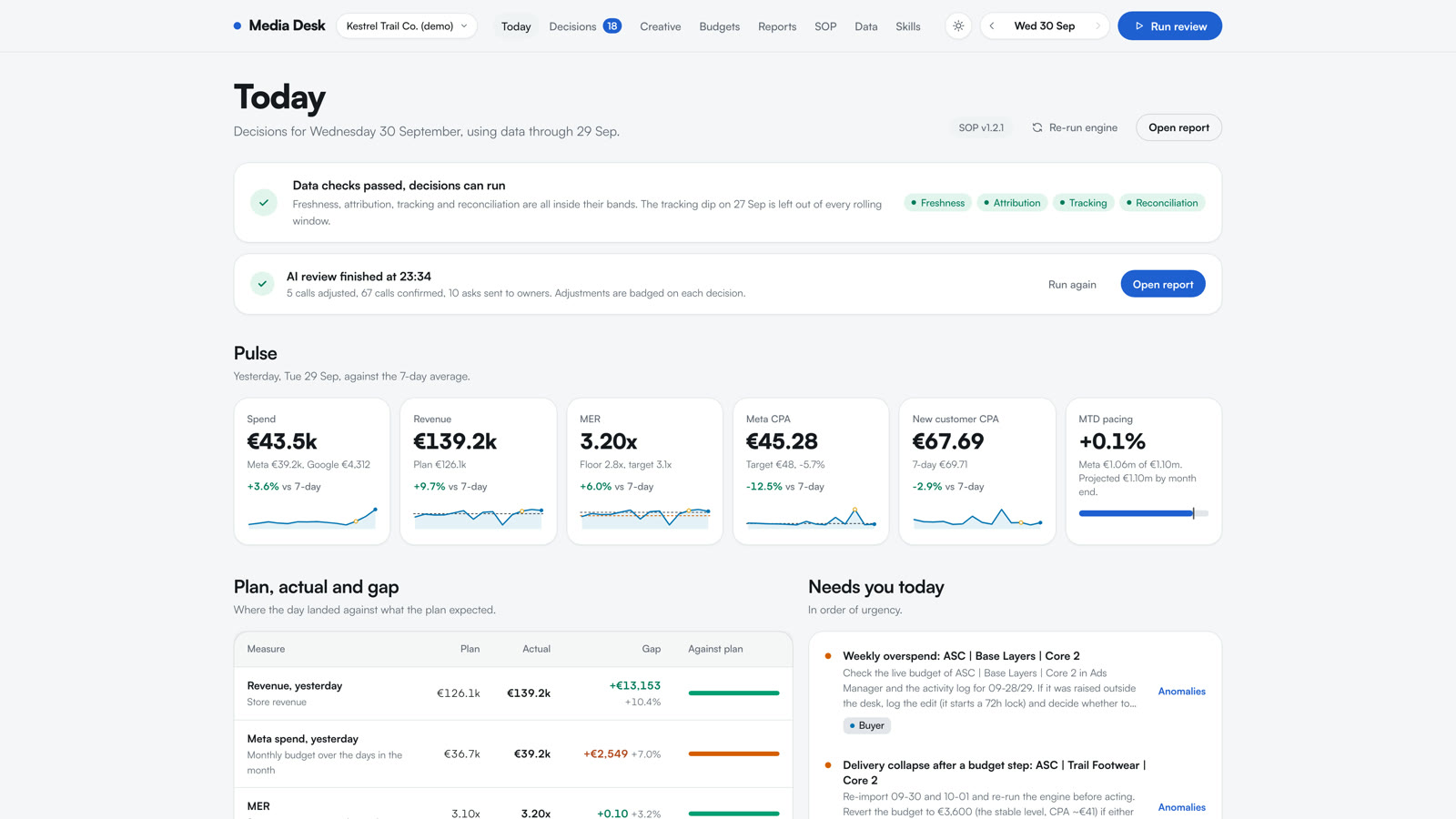
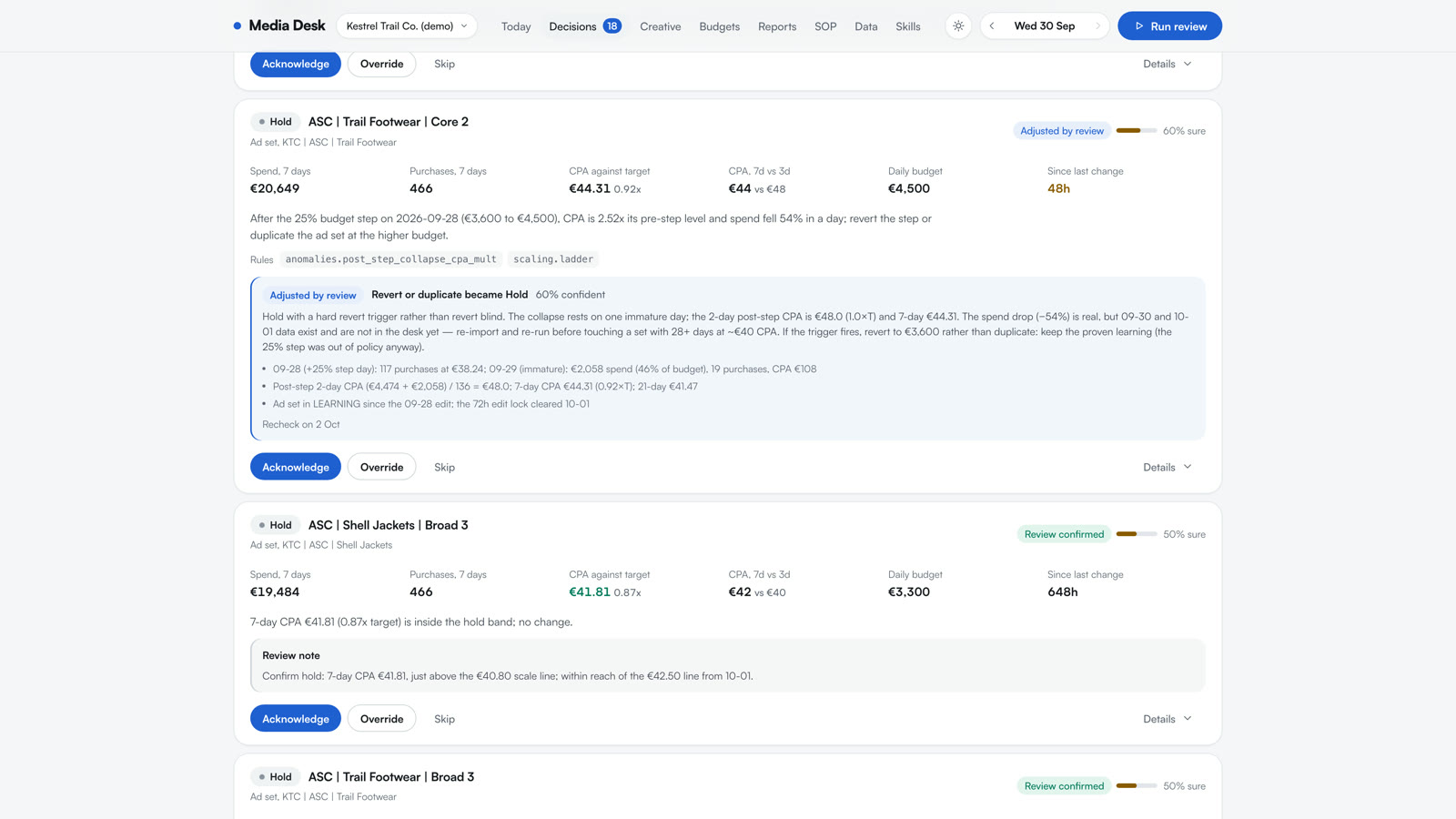
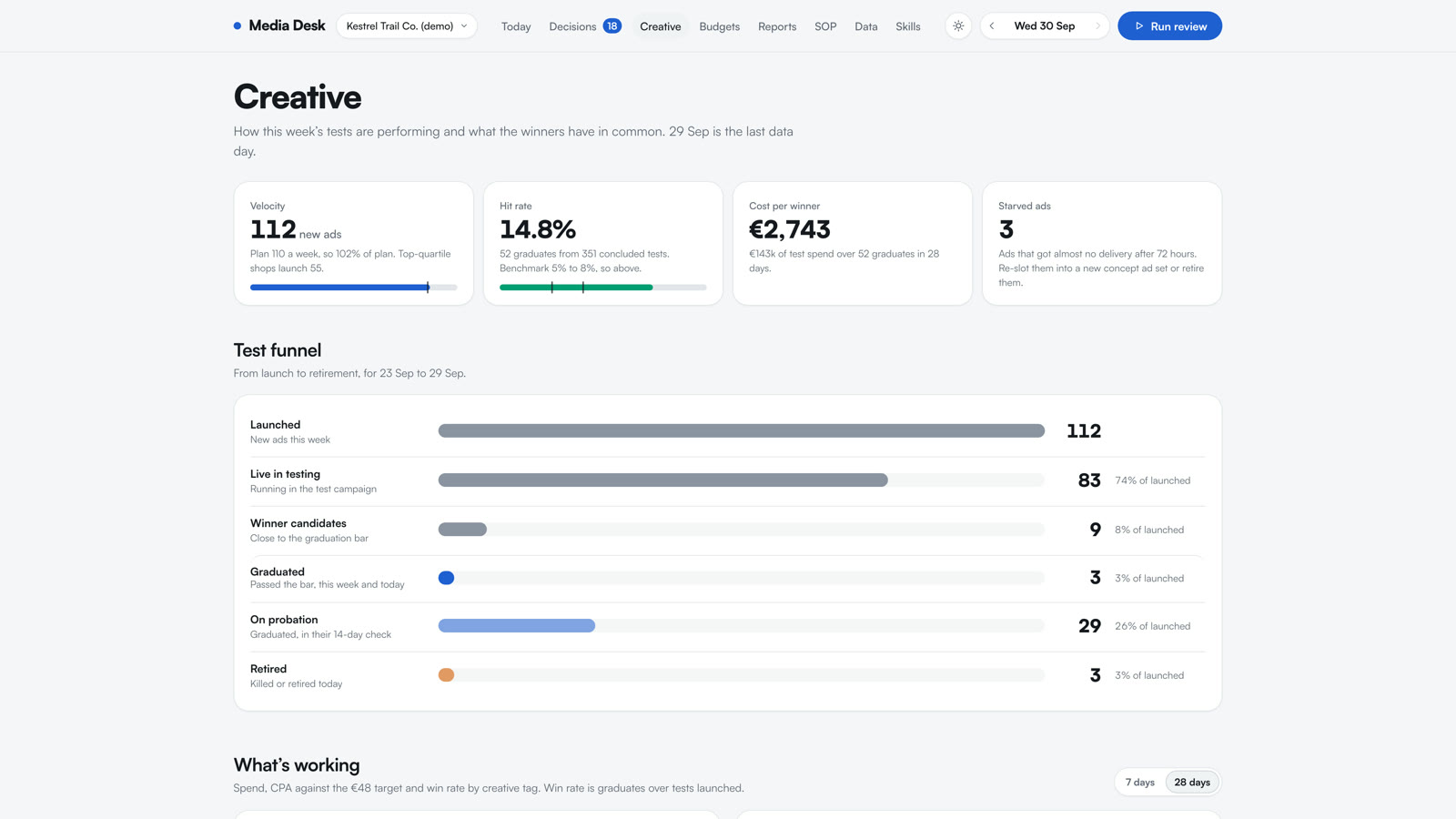
Screens from our own build on a fictional demo account. Every recommendation is approved by a person before anything changes.
What you get.
- A named senior buyer who knows your account
- Media Desk checking every ad each morning, with written reasons
- New concepts every week, drafted by Studio and chosen by a strategist
- Conversions API and tracking checked before we scale
- A weekly note and a monthly review against your own numbers
- Your ad account, data and creative stay yours
What we won’t do.
- Promise a ROAS figure before we’ve seen your margins, order values and tracking
- Scale on platform-reported ROAS alone
- Switch off the ads carrying your spend just because they’re old
- Let an agent change budgets or ads without a person approving
Questions buyers ask.
How much creative do we need?
Most accounts start with about 10 live ads and add one or two genuinely new ones a week, more as spend grows. Studio drafts them; we choose and edit.
Should we still use lookalikes or interest targeting?
Mostly no. Broad targeting with strong creative and clean data usually does better now; Meta’s own figures put Advantage+ audience at about 7% lower cost per result for sales. We keep tighter targeting for retention.
Why does Meta’s ROAS differ from Shopify?
Meta counts conversions after any interaction with an ad, including existing customers and people who would have bought anyway. We report Meta’s figure alongside blended return from your shop data.
We get fewer than 50 conversions a week. Does this still work?
Yes, with less structure: everything stays in one ad set and new ads are tested inside it, or with Meta’s built-in creative testing, rather than splitting the budget.
How fast can we scale?
Gradually: around 3% a day or bigger steps no more than every five days, while cost per sale holds. Creative supply and clean data usually limit scale more than budget.
Start with a free Meta ads audit.
A senior buyer reviews your account and sends a recorded walkthrough with the first three fixes, within three working days.
Email us to start ↗Management quoted after your free audit, plus ad spend, rolling monthly. · hello@adsandagents.com · UK-based, working with clients in the UK, Europe and North America.
Related.
Notes and sources
- Meta: about the learning phase
- Meta: best practices for ad delivery
- Meta: A/B testing best practices
- Meta: about Advantage+ sales campaigns
- Meta: best practices for the Conversions API
- Ben Heath, “The Truth About Meta’s Andromeda Update”, YouTube, 11 Nov 2025
- Ben Heath, “Meta advertisers, we’ve got a TESTING problem”, YouTube, 13 Jan 2026
- Ben Heath, “The BEST Way To Scale Meta Ads”, YouTube, 19 May 2026
- Dara Denney, “How to Test Facebook Ads Creatives at Every Budget”, YouTube, 28 Mar 2025
Official Meta and Google guidance is the baseline. Practitioner views are named with the video and date; vendor and industry figures are their own claims. Demo brands and data in the films are fictional.