The agents we use every day.
Set up for your team.
We built Studio, Media Desk and Ads Desk to run our own client accounts, and we hold them to the standard we’d want as a client: they show their reasoning, they cite the numbers, and a person approves every change. In-house teams and agencies can have them too, configured for their accounts and brand rules.
Who it’s for: in-house marketing teams spending days on checks, reports and creative variants, and agencies that need an AI capability for clients. The films show our agents on fictional demo accounts; no client results are claimed.
Is this you?
- Your team spends days a week on checks, reports and routine changes
- Creative production can’t keep up with testing
- Leadership wants AI adoption that actually works
- Clients ask your agency what its AI offer is
Why it usually goes wrong.
- Too broad, too fast. Pilots try to automate everything at once.
- No controls. Gartner expects over 40% of agentic AI projects to be cancelled by 2027, partly for weak risk controls (its prediction).
- Ungrounded output. Generic AI tools don’t read your live data or your brand rules.
- Rubber-stamping. Approvals become automatic and errors slip through.
How our agents are controlled.
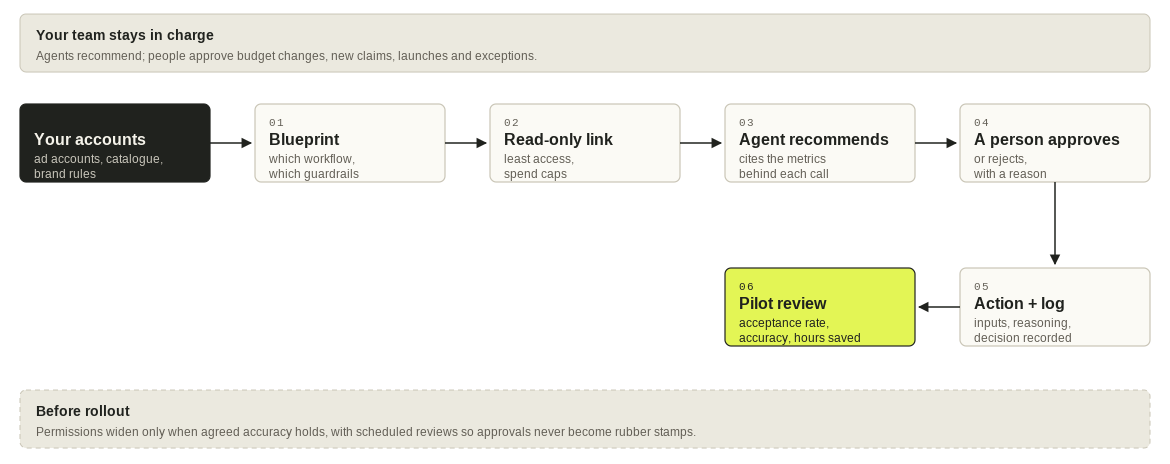
Your team stays in charge: Agents recommend; people approve budget changes, new claims, launches and exceptions.
How the work runs.
Weeks 1–3
Blueprint: map the workflows, pick one or two with clear value, set guardrails and success measures.
£1,500, fixed (draft).Weeks 4–6
Shadow mode: the agent recommends alongside your team; we measure agreement.
No risk to accounts.Weeks 7–11
Approve-only: your team approves or rejects every recommendation.
People stay in control.Then
Rollout: wider scope only when accuracy holds, plus training and support.
Earned, not assumed.The method, point by point.
- Start with one workflowThe blueprint picks one or two jobs with clear value, such as daily Meta checks or creative variants, rather than ‘AI for everything’.
- Least privilegeRead-only access by default, spend caps, a kill switch, and write access only when you choose to turn it on.
- Grounded recommendationsAgents read your live account data and cite the numbers behind every recommendation. Brand rules and banned claims are checked lists, not suggestions.
- Approval tiersBudget changes above a threshold, new claims, launches and exceptions always need a person. Low-risk actions can follow explicit rules later.
- A full audit logInputs, reasoning and decisions recorded for every recommendation, so anything can be traced.
- Your data stays yoursA UK GDPR data processing agreement, and no client data used to train models, checked against each AI provider’s terms.
- Guard against complacencyScheduled reviews of approved recommendations, so the human check stays a real check.
What we report.
- Hours savedon checks, reports and production
- Acceptance raterecommendations your team approves
- Accuracyapproved calls that turn out right
- Time to actionfrom problem to fix
- Errors caughtat the approval step
- Cost to runper account per month
The agent behind it.
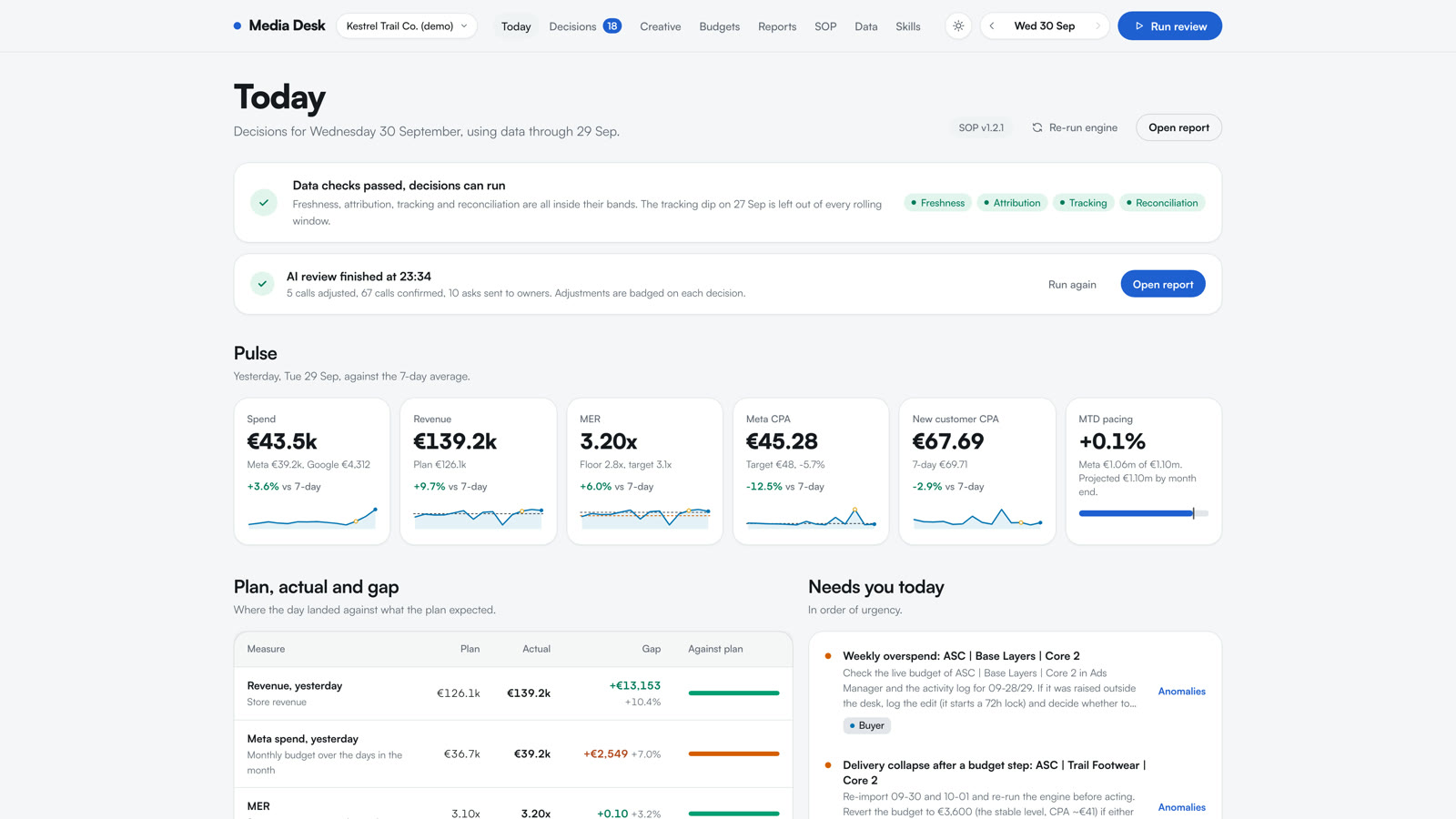
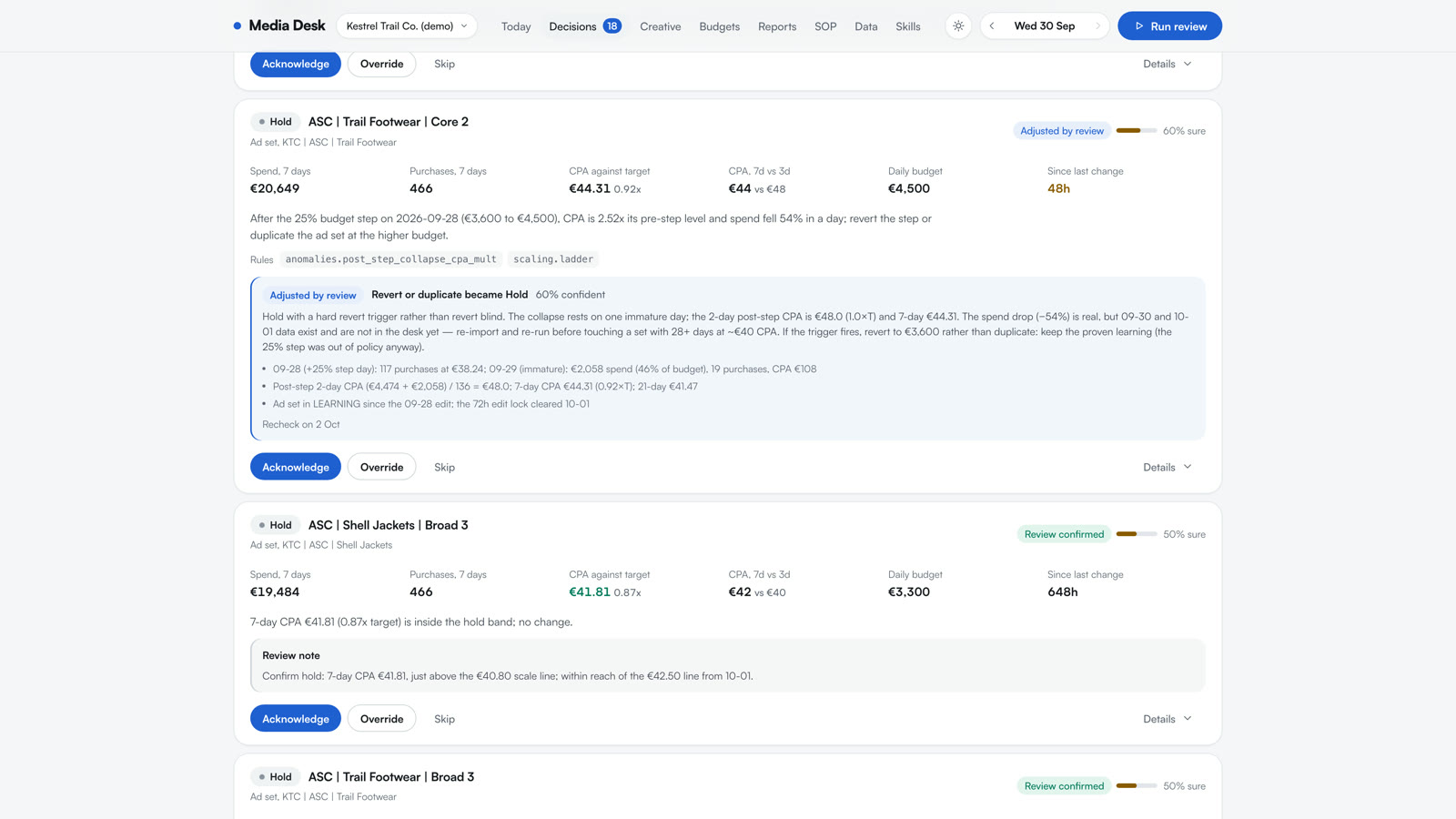
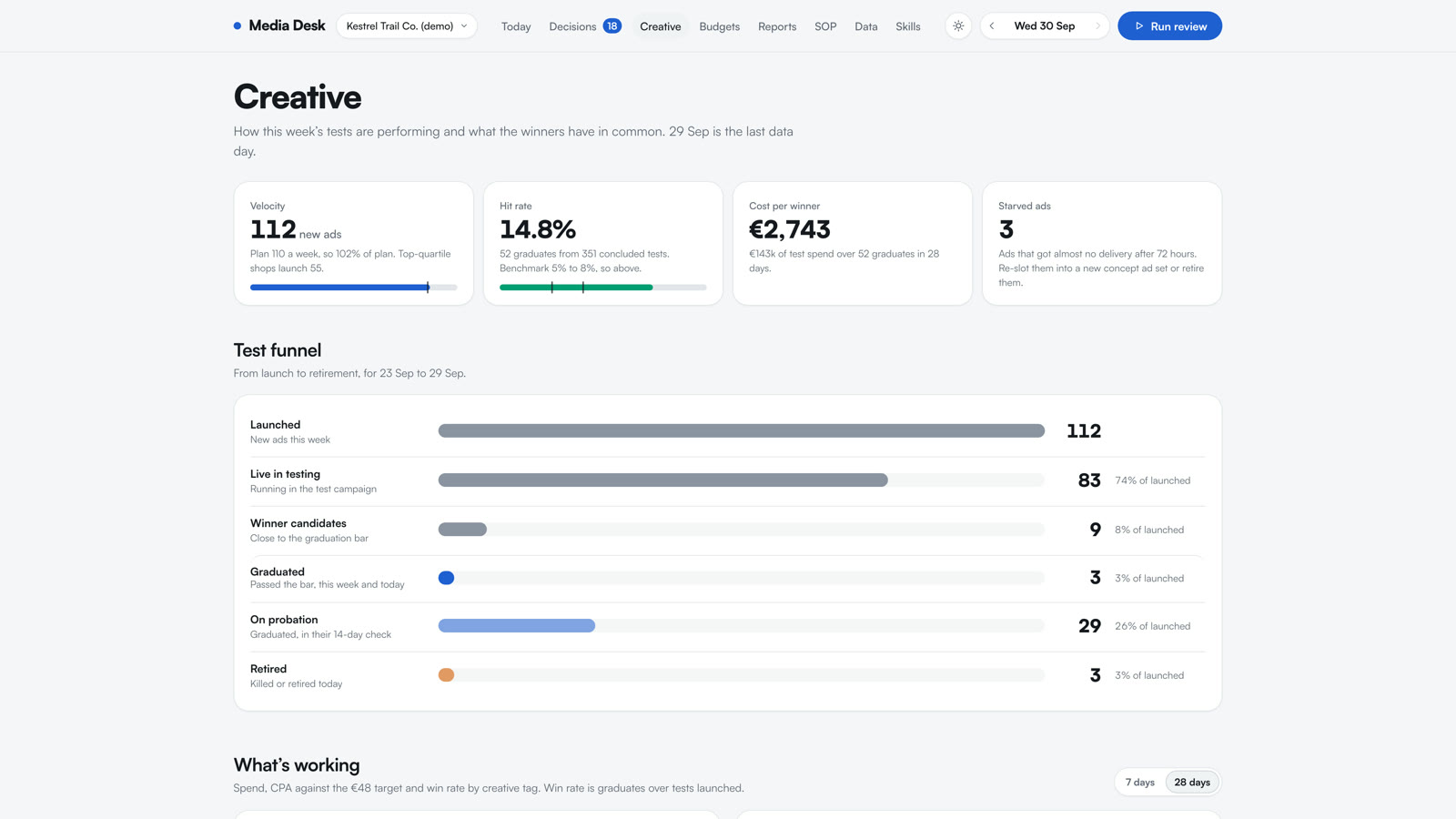
Screens from our own build on a fictional demo account. Every recommendation is approved by a person before anything changes.
What you get.
- A blueprint for one or two workflows
- Agents configured for your accounts and brand rules
- Approval steps your team controls
- A shadow-mode and approve-only pilot
- Training and documentation
- Ongoing support if you want it
What we won’t do.
- Give agents unsupervised control of budgets or publishing during a pilot
- Claim autonomy we can’t audit
- Use your data to train models
- Replace your team; the point is to give them back their week
Questions buyers ask.
Can it spend money without us?
No. Access is read-only by default, and every change is approved by a person. Write access is a switch you control.
Where does our data go?
It stays in your accounts and our controlled environment under a data processing agreement. We check each AI provider’s terms so your data isn’t used for training.
What happens when it’s wrong?
A person rejects the recommendation and records why, and that feeds back into the agent’s rules. That’s what the approval step is for.
Does it replace our team?
No. It takes the repetitive checking and drafting off them, so their time goes on decisions.
Talk to us about agents for your team.
Tell us what your team spends too long on. We’ll tell you whether an agent would help, and what a small pilot would look like.
Email us to start ↗Blueprint £1,500; pilot scoped and priced up front. · hello@adsandagents.com · UK-based, working with clients in the UK, Europe and North America.
Related.
Notes and sources
- Human-in-the-loop AI in marketing (cites Gartner)
- Human-in-the-loop approval patterns
- AI marketing statistics 2026 (survey roundup)
Official Meta and Google guidance is the baseline. Practitioner views are named with the video and date; vendor and industry figures are their own claims. Demo brands and data in the films are fictional.