Thirty-five markets in.
Decisions you can check, out.
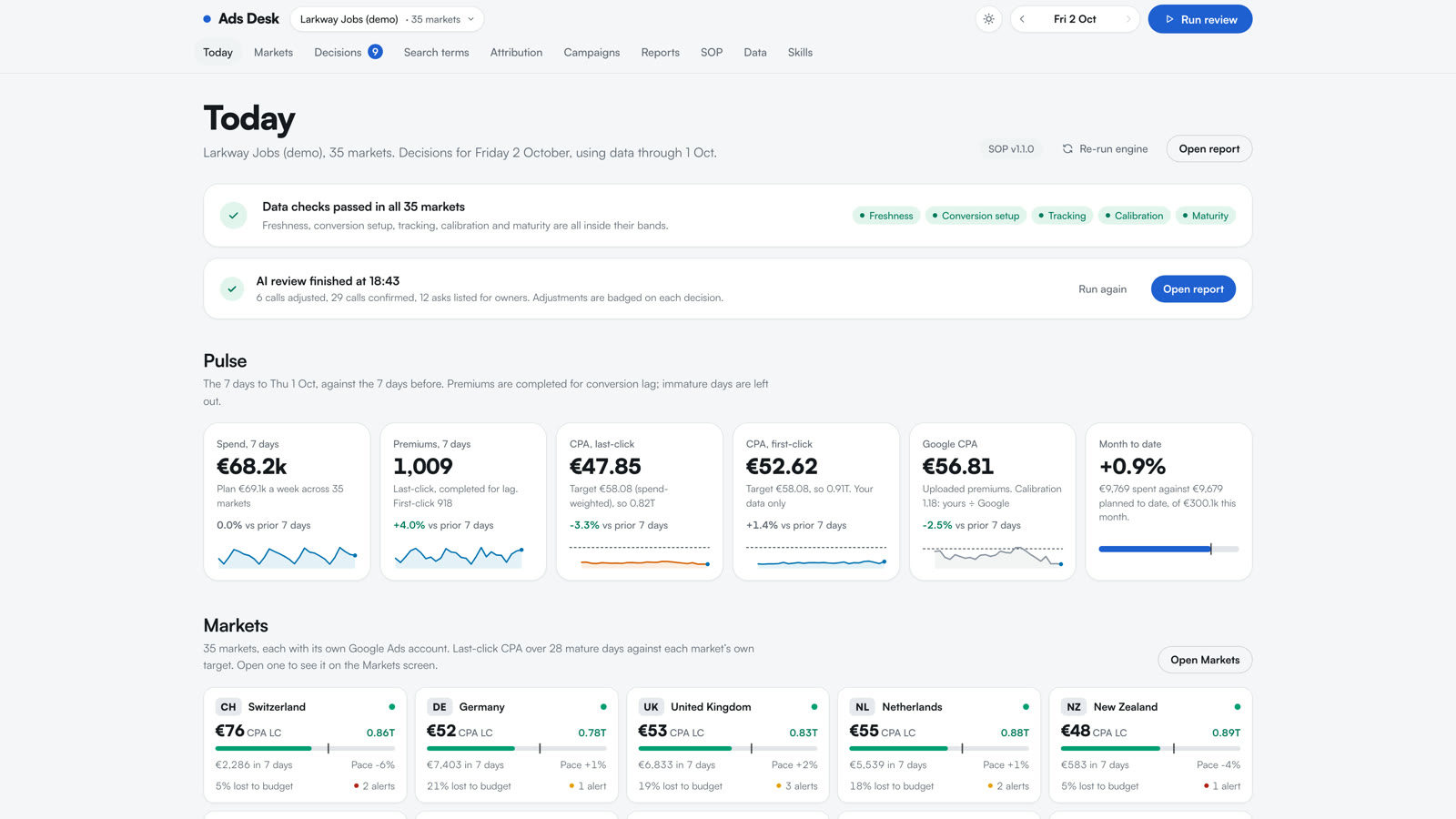
Ads Desk does a senior Google Ads specialist’s daily work across a portfolio of country accounts. It judges Google on your own CPA, first click and last click, ranks problems in euros a week, and hands you copy-ready changes. Nothing touches the account without you.
Demo client: Larkway Jobs is fictional and its data is synthetic, built to behave like a listings aggregator: 35 markets, about €300,000 a month, free sign-ups that mature into paid premium memberships. No results are claimed; impact would be measured decision by decision on a real account.
The daily loop.
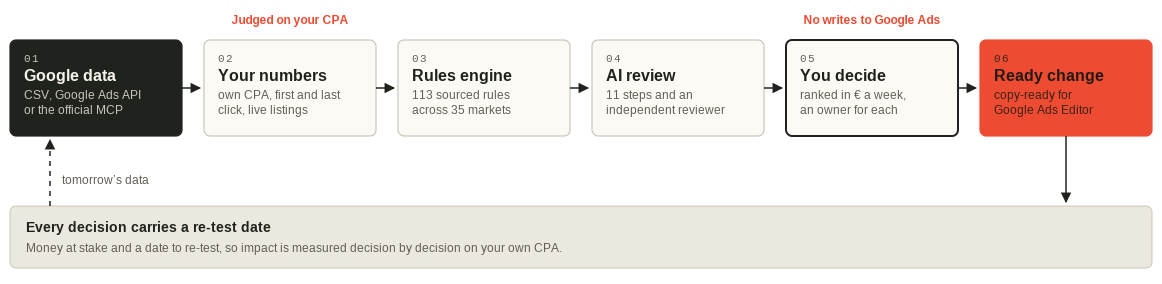
Google no longer offers a first-click model, so the desk uses yours. Brand and Demand Gen are judged on first click; generic search must pass on both. It waits for sign-ups to mature into paying members before it calls anything a drop.
Germany, worked through.
The opportunity
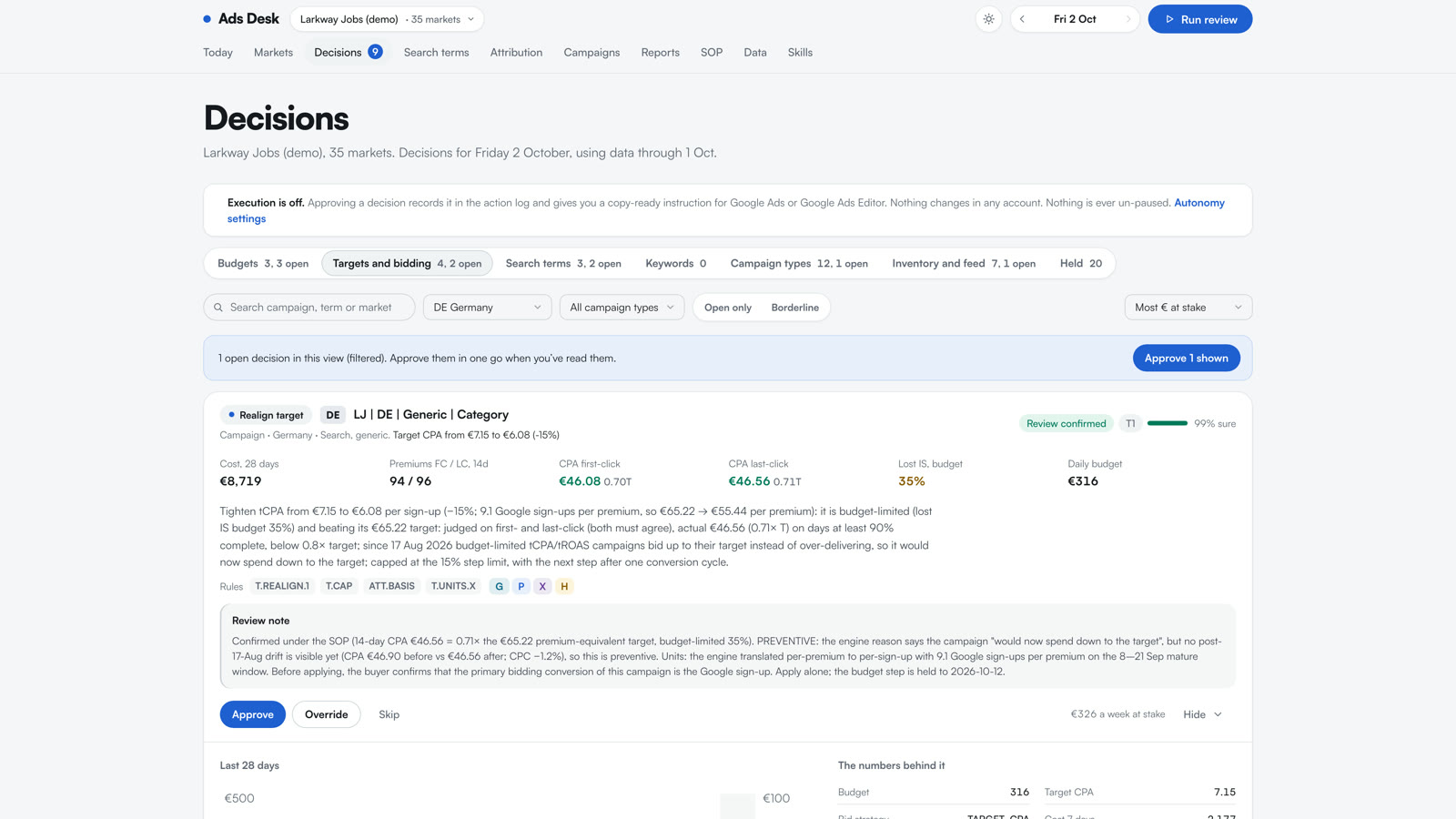
Germany is under target. Its generic campaign runs at about seven-tenths of target on first and last click, yet loses 35% of its impressions to budget.
35% IS lostTarget first
A budget-limited campaign bids up to its target, and Germany’s is looser than it achieves. The desk converts your cost per premium into Google’s cost per sign-up and tightens it, one capped step.
€7.15 → €6.08 (−15%)The review holds
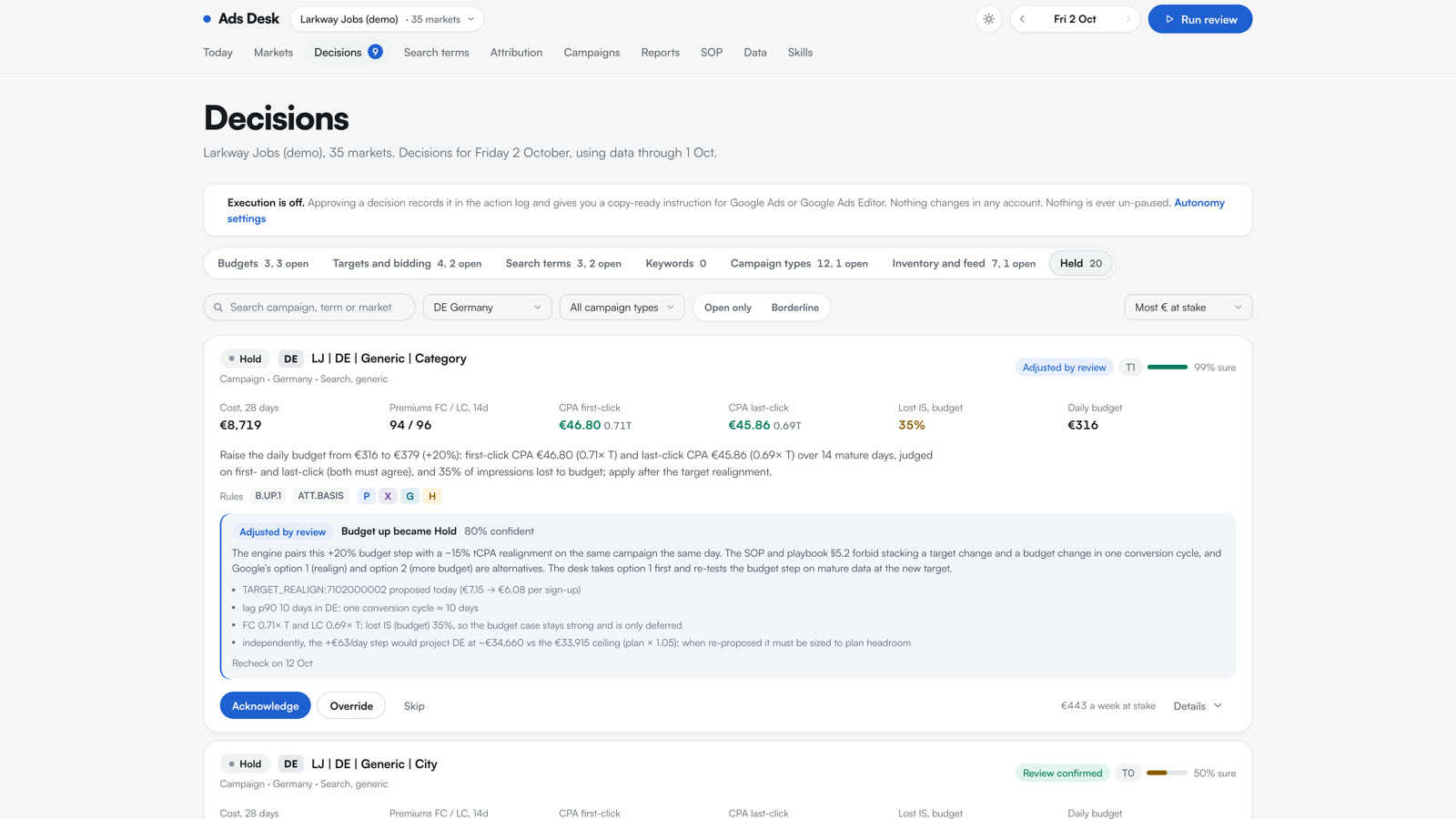
The engine also wanted 20% more budget. The AI review held it back: never change a target and a budget in the same conversion cycle.
Re-test 12 OctThen the money moves
When the hold lifts, Germany is first in line. The reallocation is modelled, not approved: from markets above target, never more than 10% of the portfolio a week.
The target maths: €65.22 per premium ÷ about 9.1 sign-ups per premium = €7.15 per sign-up, moved no more than 15% a step. Brand looks brilliant on last click and poor on first, so it is watched, not scaled, with a geo holdout proposed. Demand Gen is the reverse and is judged on first click.
The decisions in one run.
Engine output for 2 October across the Larkway portfolio. Problems come first in the app, ranked by euros a week, each with an owner: finance for a budget about to run out, the buyer for a delivery drop after a manual edit.
Inside the app.
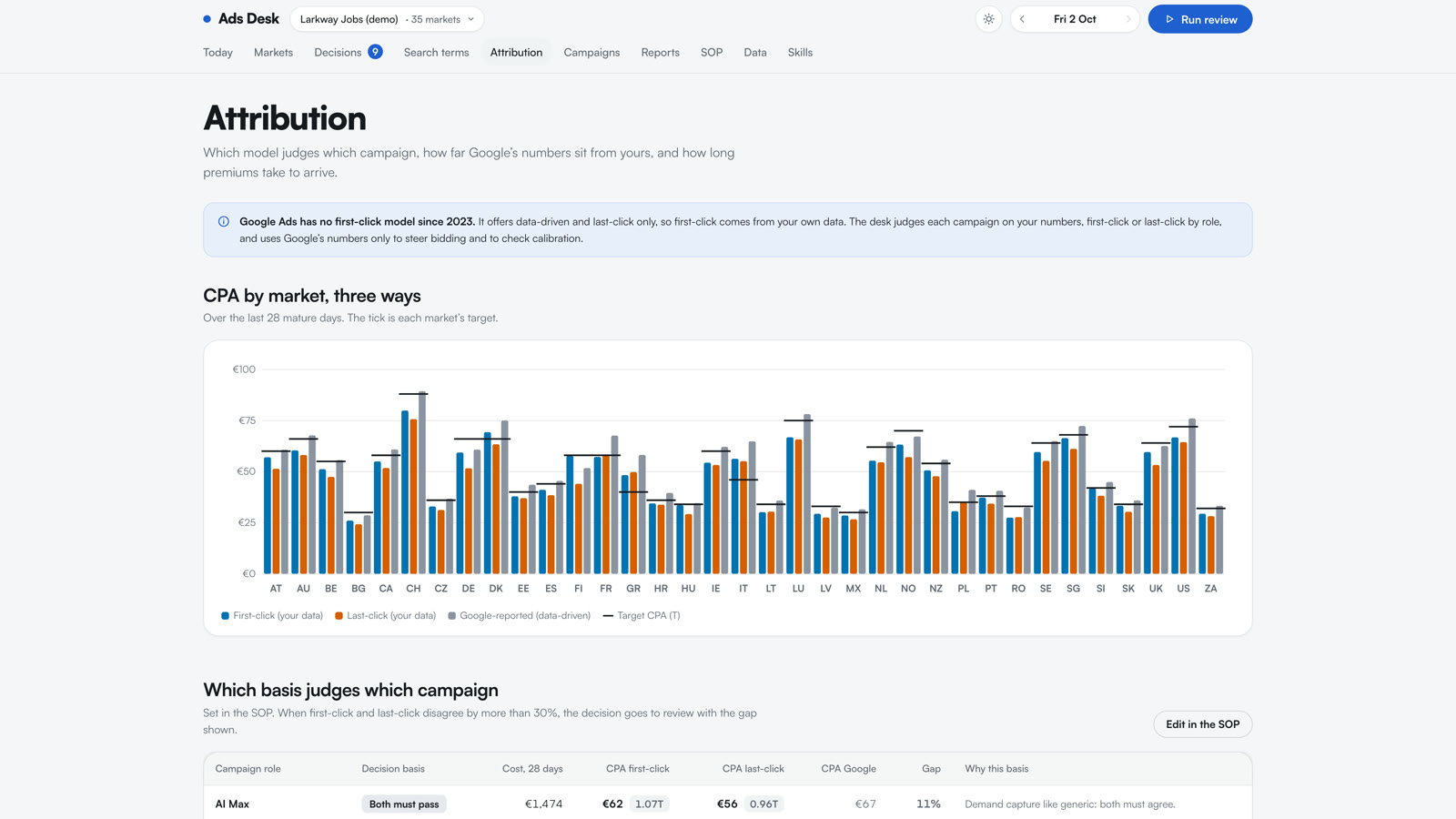
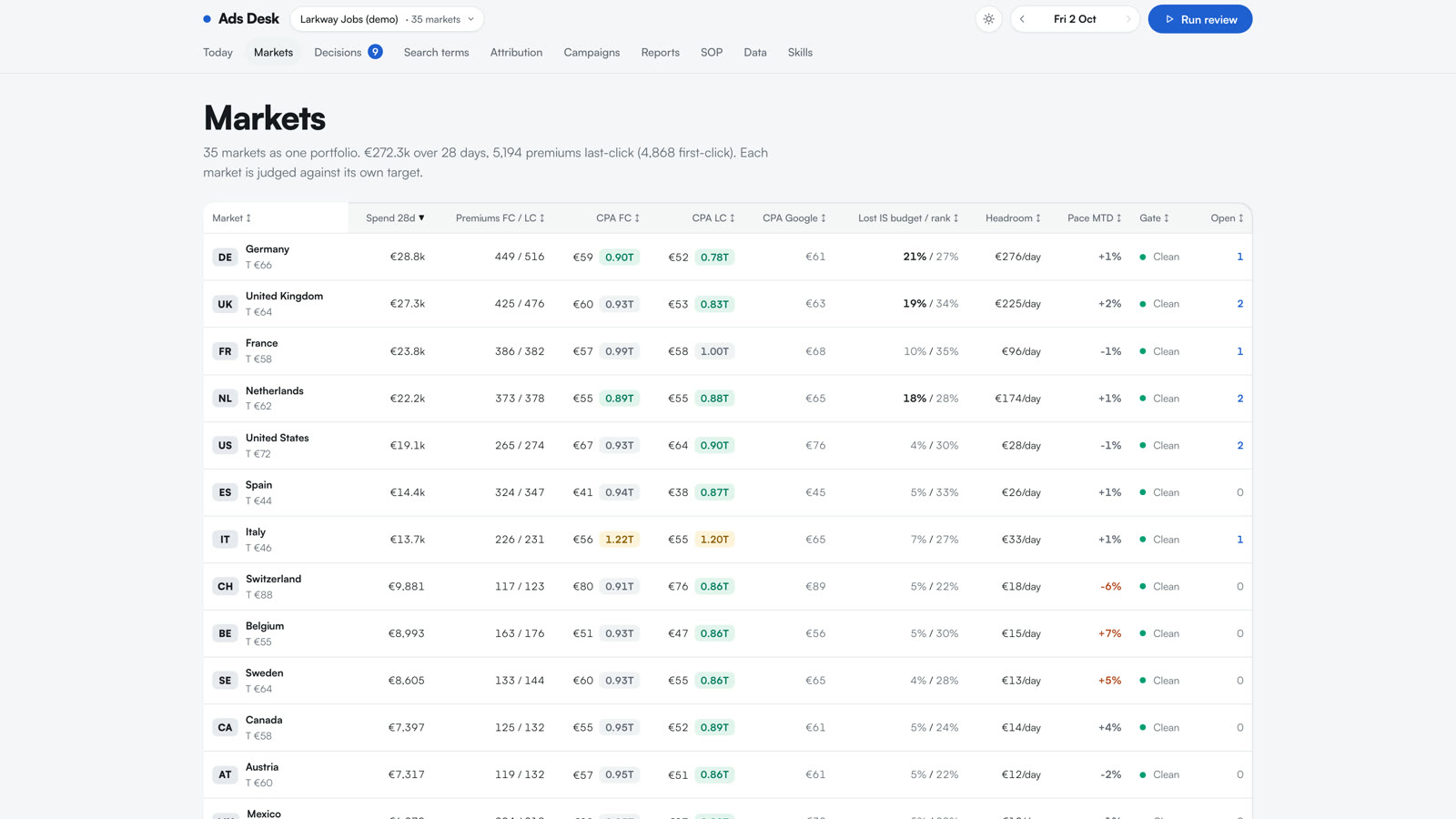
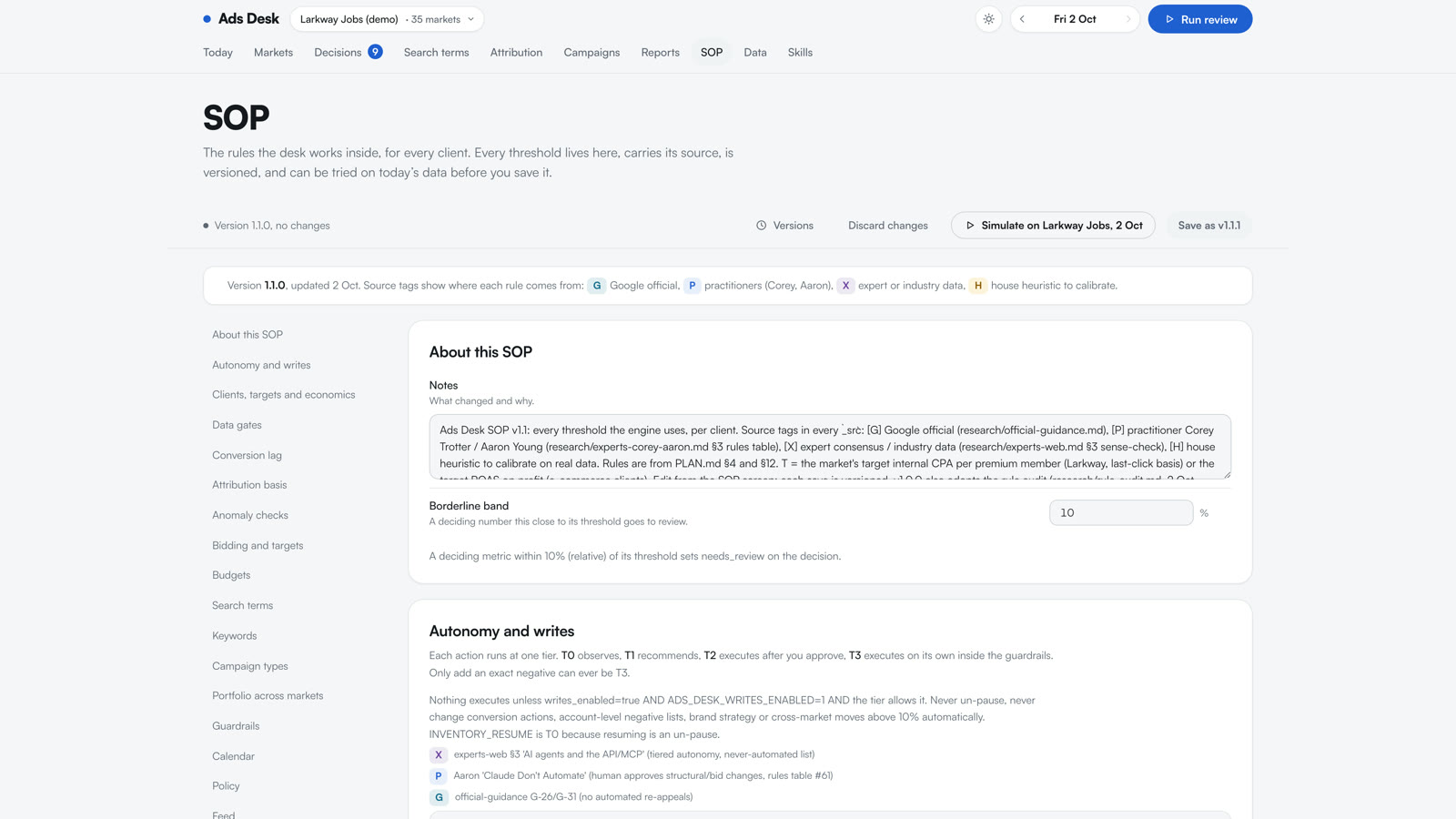
Built from evidence.
The rules come from 224 pages of Google’s own guidance, 124 published expert positions and 67 practitioner sessions. They became a playbook of 113 rules, each checked back against its source and each one yours to change. The desk knows how each campaign type fails, such as brand traffic leaking into Performance Max.
What it would need from you.
- Read access to your Google Ads manager account.
- A daily export of your own conversions, with first and last click.
- A target for each market.
Data can come by CSV, the Google Ads API or Google’s official MCP server.
What a multi-market team could commission.
Ads Desk on your accounts, judged on your internal CPA and attribution, with your targets and approval rules. It starts read-only: approving a decision logs it and produces a change ready for Google Ads Editor.
Discuss Ads Desk ↗Source and scope.
Folder: skill based creative pipelines/google ads media buy/ads-desk. Run shown: runs/larkway/2026-10-02 (run.json: 49 decisions, 14 anomalies; review.json: 6 overrides; SOP v1.1.0). Research: research/rule-audit.md, official-guidance.md, experts-web.md, experts-corey-aaron.md. Film: ads-desk-walkthrough.mp4 (2 October 2026). Larkway Jobs is a fictional demo client.